

A calmer school morning as a single parent starts with the time you genuinely need to leave. Work backward, assign the essentials a familiar place and decide what you can drop on a difficult morning.
Work backward from the real departure time
Before creating a morning routine, think about the time you really need to leave home. This might depend on when the school bus arrives, how long it takes to drive to school, or what time you’re expected to be at work. Remember to include things like walking to the bus stop, finding parking, or getting your children inside the school.
Once you know when you need to leave, work backward to figure out how much time you have for breakfast, getting dressed, brushing teeth, and gathering school supplies. Try to be realistic about how long these things usually take instead of planning around the fastest morning you’ve ever had.
If you have a child that normally needs fifteen minutes to get dressed because they need help with buttons or shoes, don’t plan on them being ready in five minutes. If you’re trying to fit more responsibilities into the morning than you have time for, you might need to change the order of certain tasks or prepare something ahead of time.
Build the smallest repeatable routine
Children often do better when they know what to expect, especially during busy school mornings. Having a familiar routine can help them understand what they need to do without having to ask you about every step.
You might decide that your family will eat breakfast, brush their teeth, get dressed, get their stuff together, and then leave for school. Another family might find that getting dressed before breakfast works better for them. There isn’t one routine that everyone has to do so pick one that fits your needs.
According to the CDC’s guidance on routines and rules, predictable routines can help young children understand what to expect. You can use this idea when creating a morning schedule that fits your children’s ages and abilities.
Set out the essentials the night before
One way to make mornings easier is by taking care of something that usually causes problems before you go to bed. Your child might forget their homework a lot, can’t find the right shoes, or need a particular item for school. Preparing these things ahead of time can prevent you from having to search for them when you’re already running late.
If your child needs something like a signed permission slip for a field trip, you could sign it and put it in their backpack the evening before. You might also check that their school supplies are ready or make sure they have clean clothes available for the next day.
But remember that preparing for the morning shouldn’t make your evenings more stressful. If you’re already exhausted after working and taking care of your children, you probably don’t want another long list of things to accomplish before bedtime.
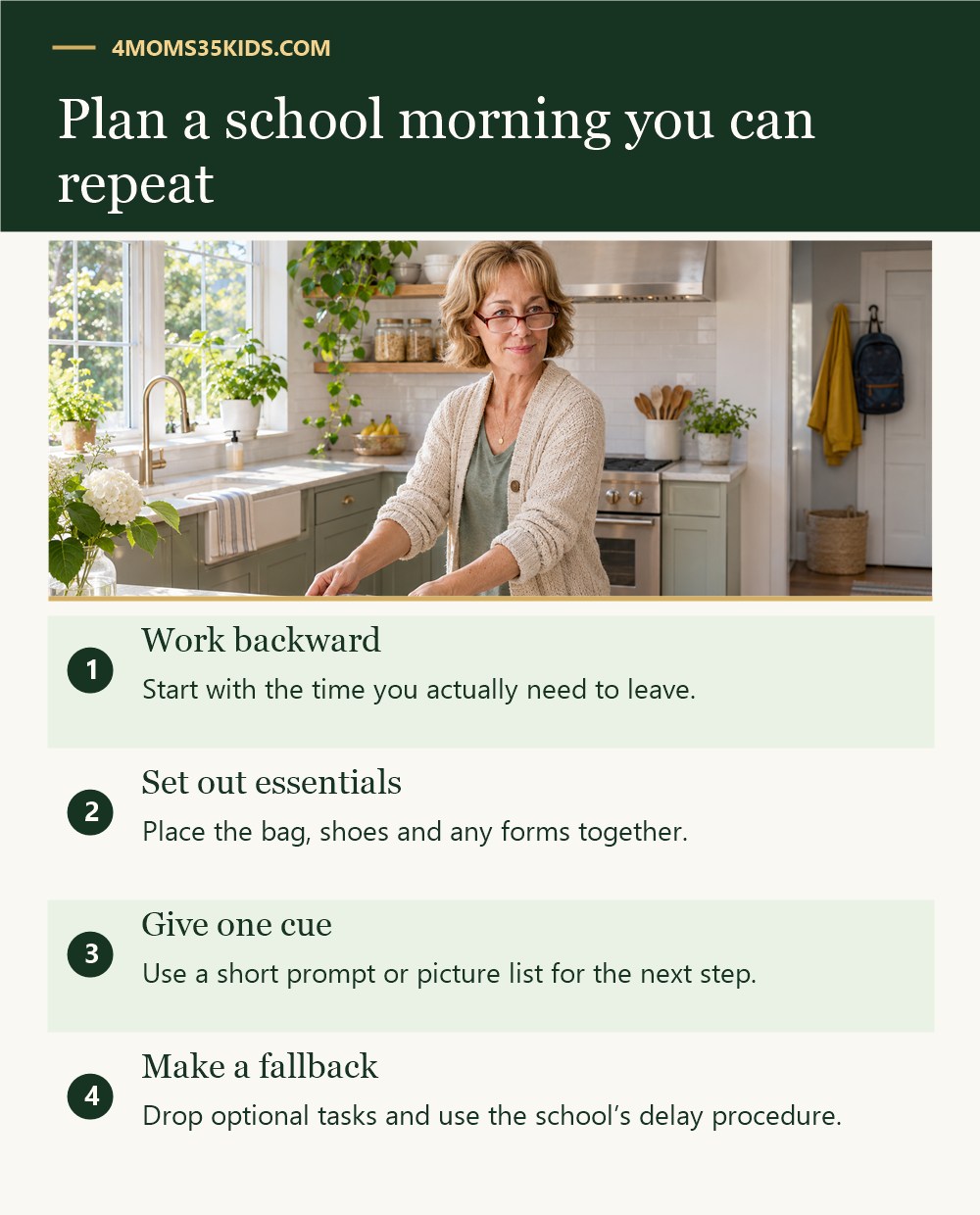
Read the visual guide as text
- Work backward. Start with the time you actually need to leave.
- Set out essentials. Place the bag, shoes and any forms together.
- Give one cue. Use a short prompt or picture list for the next step.
- Make a fallback. Drop optional tasks and use the school’s delay procedure.
Give children a job they can practise
Even though you’re the parent responsible for getting everyone ready, your children might be able to help with certain parts of their morning routine. The important thing is making sure that what you’re asking them to do fits their age, abilities, and level of independence.
A child that is younger might be able to put their shoes beside the door or place their lunchbox in their backpack. An older child might be able to check a short list to make sure they have their homework, school supplies, and other belongings.
But just because a child can do something on their own doesn’t mean they’ll always be able to do it without your help. A child who normally gets dressed on their own might still need assistance when they’re tired, upset, or having a difficult morning.
Include your own preparation
When you’re a single parent, it’s easy to spend so much time helping your children that you forget about everything that you have do for yourself. You might need to make sure everyone has breakfast, clean clothes, and school supplies, only to realize that you haven’t found your own keys or prepared what you need for work.
Your morning routine needs to include what you need for yourself such as your clothing, meals, medication, transportation, and anything else you need before leaving home.
If you’re always spending a few minutes looking for your work badge or car keys, you might start putting them in the same place each evening and if packing your lunch in the morning causes problems, you could prepare part of it at another time that works better for you.
Use a short transition cue
Some children have a hard time stopping one activity and moving on to another, especially when they’re enjoying what they’re doing. Your child might be watching television, playing with toys, or finishing breakfast when it’s time to get dressed.
Instead of suddenly telling them to hurry, try giving them a reminder before the next activity. You might say, “We’re almost finished with breakfast, and then it’s time to brush your teeth.” This lets your child know what’s coming next.
According to the Head Start guidance on schedules and routines at home it discusses the importance of routines that work for individual families. You can use reminders, pictures, or familiar sounds if those things help your child understand when it’s time to move on.
Agree on a difficult-morning plan
Even when you’ve prepared everything ahead of time, some mornings aren’t going to go as planned. Your child might wake up late, something important could be missing, or an unexpected problem might leave you with less time than usual.
Having a backup plan can help you decide what to do without feeling like you have to figure everything out while you’re already stressed.
Start by thinking about what absolutely needs to happen before leaving. Your children need appropriate supervision, necessary care, suitable clothing, and arrangements for food and transportation. Other things might be able to wait.
Adjust the part that keeps causing delays
Sometimes one small problem can affect several parts of your morning routine. Instead of trying to change everything at once, look at what’s happening when things become stressful.
Think that a single mother named Jessica has two children, Emma and Tyler. Every morning, Jessica is trying to help Emma get dressed while Tyler keeps asking where his school supplies are. At the same time, Jessica is preparing breakfast and trying to get herself ready for work.
After several difficult mornings, Jessica realizes that Tyler searching for his belongings is one of the biggest reasons everyone gets behind schedule.
Ask the school about recurring issues
Sometimes the problems you’re having in the morning might involve something that you can’t solve at home. Maybe your child is having a difficult time going to school, there’s a transportation problem, or you’re struggling with a pickup or arrival arrangement.
When these situations keep happening, it can help to contact the school and explain what’s going on. You might talk to your child’s teacher, school counselor, transportation office, or another staff member who can help you understand what options are available.
If your child gets upset every morning before school, you might say, “My child has been having a really hard time getting ready for school. Is there someone I can talk to about what might be happening?”
Related reading. Single Parenting: Routines, Support and Everyday Connection.
Frequently asked questions
1. How can I make school mornings easier as a single parent?
Start with the time you need to leave, then organise only the essentials. Give bags and shoes a familiar place and pick one task to prepare the night before.
2. What should I prepare the night before school?
Set out high-friction essentials such as a packed bag, signed form, shoes and weather-appropriate clothing. Leave room for needs that change in the morning.
3. How can children help with the routine?
Choose one task they can learn, such as putting a lunch box by the bag. Practise it outside the morning rush and use a brief reminder.
4. What can I do on a morning when we are already late?
Use the essentials-only routine, contact the school if needed and keep transport safe. Review what slowed you down once the rush is over.
5. How do I adapt a routine that keeps breaking down?
Notice the step that regularly stalls. Try changing only that step for several days, and ask the school about attendance or arrival support if appropriate.