

You can enjoy someone’s company and still feel exhausted afterward. Noise, emotional conversations, caregiving, trying to follow several people at once or simply a busy day may leave little room to recover. Feeling overwhelmed deserves attention without turning it into a verdict about your personality.
Some people describe this experience as sensitivity or absorbing other people’s energy. That language may be meaningful to you, but the feeling alone cannot establish its cause or tell you exactly what someone else is thinking. Start with what you can notice and what would make the next interaction more manageable.
On this page
Notice what happened before the exhaustion
If you have the space, make a brief note after a demanding interaction. This is an observation exercise, not a test for being an empath or a highly sensitive person.
- Setting: Was it crowded, bright, noisy or difficult to leave?
- Demands: Were you listening to distress, managing conflict or caring for children at the same time?
- Your starting point: Were you already tired, hungry, in pain or worried about something?
- What helped: Did a quieter room, a shorter visit or practical help make a difference?
A pattern may suggest an adjustment. It does not prove that another person transferred emotions to you, or that you have a particular condition, attachment style or trauma history.
Try a small reset you can actually use
You may not have an empty house or a long stretch of time alone. Choose something modest: sit away from the busiest conversation, lower background sound, have a drink of water or pause before replying to more messages.
If attention to breathing feels helpful, try a comfortable pace without forcing deep breaths. If it makes you uneasy, focus on an ordinary object or the support of the chair instead. A quiet prayer or familiar reflection can also be a personal source of comfort. You do not need smoke, special products or a ritual to earn a break.
Ask what would reduce the immediate demand, rather than expecting yourself to feel cheerful straightaway. Recovery may mean doing less for a while.

Choose one workable limit for next time
A boundary can be specific and ordinary: “I can stay until three,” “I can listen for a few minutes, but I can’t troubleshoot tonight,” or “Let’s talk somewhere quieter.” You can care about someone and have limited capacity.
Where possible, build in a pause between a demanding visit and the next commitment. If you cannot shorten the interaction, consider whether part of the task can be shared, delayed or simplified. You do not have to withdraw from every social situation to take your needs seriously.
Care about someone without taking over their problem
Hearing that a friend is upset can affect you. You can acknowledge that response without deciding you must solve their situation or that their feelings have become yours to manage.
Try asking, “Would you like me to listen, or is there one practical thing you need?” Offer only what you can reasonably provide. Someone else may still feel disappointed, and that does not automatically make your limit unkind.
If a conversation includes threats, humiliation or pressure, focus on the behaviour itself. Being sensitive does not make you responsible for another person’s mistreatment.
Make room for recovery within family life
For parents and carers, “just take time for yourself” may overlook real responsibilities. A smaller adjustment can be more useful: an easier meal after a busy event, fewer optional stops, a quiet activity together or an explicit request for help with one task.
If another adult is available, describe the task rather than hoping they notice: “Can you handle bedtime while I sit quietly for a little while?” If help is unavailable, consider what can safely wait. Your home does not have to be perfectly organized before you rest.
Our article on caring for yourself when you feel overwhelmed explores a gentler response to difficult days.
Seek more support when the pattern keeps affecting your life
If exhaustion or distress is persistent, unfamiliar or disrupting daily activities, consider talking with a qualified health professional. They can help you explore possible causes rather than asking you to settle on a sensitivity label.
The NHS guide to stress describes common signs and routes to support. You can also bring a short record of what you have noticed. The aim is to make life more manageable, not to prove you should be able to tolerate every demand.
Read the infographic in text
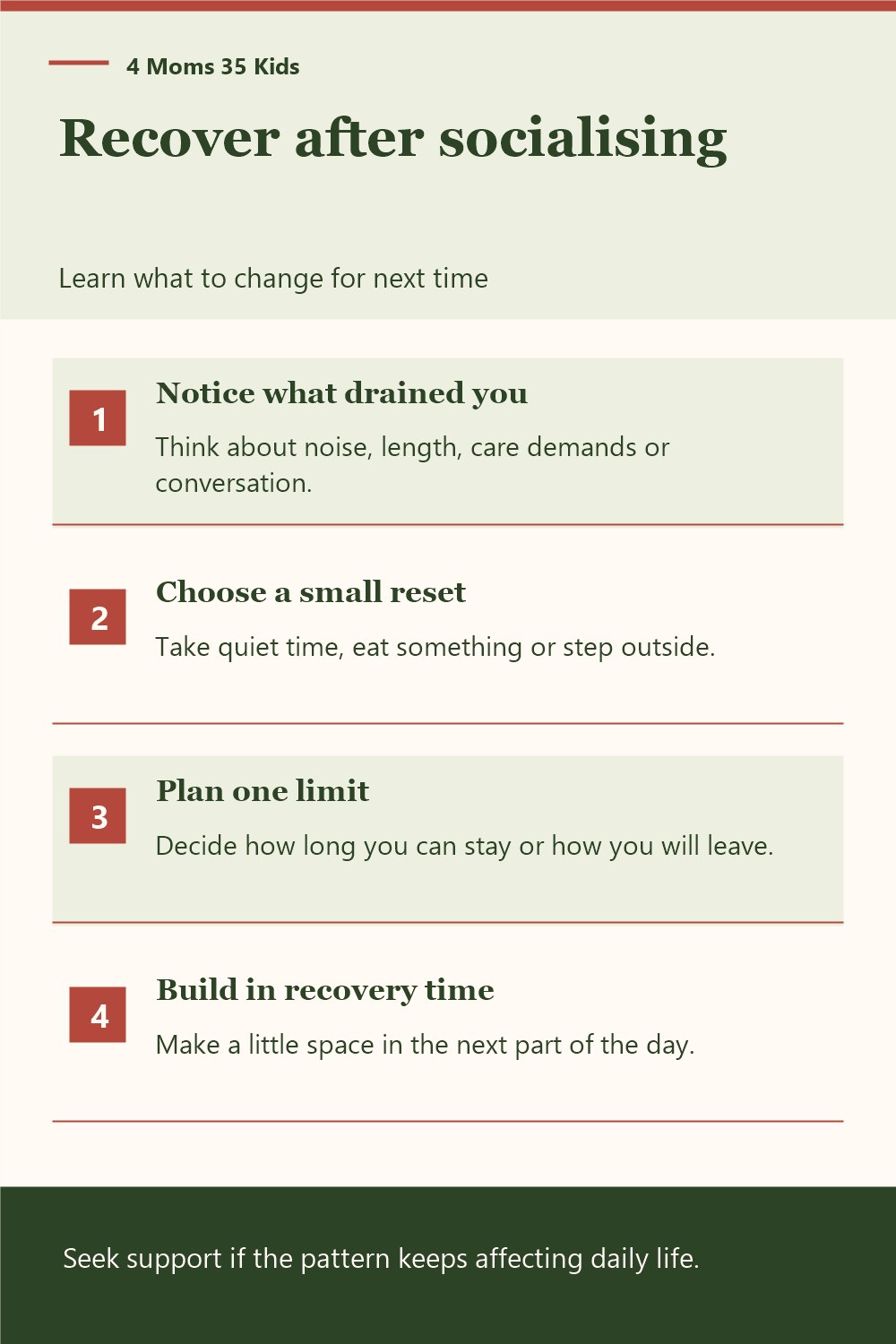
Recover after socialising Learn what to change for next time
- Notice what drained you Think about noise, length, care demands or conversation.
- Choose a small reset Take quiet time, eat something or step outside.
- Plan one limit Decide how long you can stay or how you will leave.
- Build in recovery time Make a little space in the next part of the day.
Seek support if the pattern keeps affecting daily life.