

Attraction is personal. A relationship does not come from mastering a list of traits that all men supposedly want, and you do not have to hide your needs or become someone else to deserve interest.
These ideas are for adult dating, including when work, parenting or other responsibilities shape your time. Use them to notice how you relate to each other and whether you would like to keep getting acquainted.
In this guide
- Ask what matters to this person
- Allow honest feelings
- Share the conversation
- Keep your interests and connections
- Let confidence grow at your own pace
- Choose a style that feels like yours
- Notice everyday kindness
- Talk about support without shame
- Say what you think and need
- Look for humour you both enjoy
- Try something new by choice
- Consider whether the interest is mutual
1. Ask what matters to this person
No list can tell you what every man finds attractive. Preferences differ, and attraction does not always become a compatible relationship. Rather than performing a set of qualities, ask about the person’s interests, expectations and reasons for dating.
You are choosing too. Notice whether their answers leave room for the kind of relationship you want, including the time and responsibilities already in your life.
2. Allow honest feelings
You do not have to be cheerful throughout every date or hide a difficult day to seem appealing. You can decide how much to share while being honest about your mood.
A small explanation can be enough: “It has been a long day, but I’m glad we could meet.” You do not need to turn disappointment into a joke or find a positive lesson immediately.

3. Share the conversation
Conversation can include questions, listening and sharing something about yourself. Try an open question about an interest they have mentioned, then allow the answer to lead somewhere rather than treating the date as an interview.
Quiet moments are not an automatic sign of failure. If the conversation repeatedly feels one-sided, notice that pattern instead of making it your job to keep everything moving.
4. Keep your interests and connections
You can enjoy getting to know someone while keeping room for your own friends, interests and family commitments. You do not need an impressive hobby or an unusually exciting life to be worth knowing.
Talk about something you actually enjoy, even if it is ordinary. Notice whether you can show interest in each other without having to share every activity or spend all your free time together.
5. Let confidence grow at your own pace
Confidence does not have to look bold or effortless. You might feel nervous and still ask a question, suggest a place or say that a plan does not work for you.
Try one choice you can make for yourself, such as an activity you enjoy or a date length you can manage. Having insecurities does not make you less deserving of care and respect.
6. Choose a style that feels like yours
Clothes, hair and makeup can be forms of expression, but there is no required look that wins a person’s commitment. Wear what suits your comfort, circumstances and preferences.
You do not owe someone a different body or a more polished appearance to justify their interest. If you want to change your style, let it be a choice you enjoy rather than a test you must pass.
7. Notice everyday kindness
Look at how you both handle ordinary moments: listening to an answer, correcting a mistaken order or responding when a plan changes. Courtesy can coexist with speaking up when something is wrong.
You can make a clear request without pretending to be satisfied. The useful question is whether you can both respond with consideration, not whether you can remain perfectly calm in every situation.
8. Talk about support without shame
Having needs is part of a relationship. Work, parenting, disability, money and energy can affect what you can offer or arrange. You do not have to prove that you never need help.
When a practical issue matters, discuss it clearly: “Evenings need advance planning for me.” Listen to what the other person can realistically offer, and consider whether the arrangement works for both of you.
9. Say what you think and need
It is useful to know where you agree and where you differ. You can express a preference without turning it into a debate: “I’d prefer a quieter place,” or “I’m looking for a committed relationship.”
Not every difference needs solving. Some can be accommodated; others may mean you want different things. Agreeing automatically makes it harder to discover that distinction.
10. Look for humour you both enjoy
Shared laughter can be an enjoyable part of dating, but you do not have to laugh at a joke that makes you uncomfortable. Notice whether humour leaves you both included rather than making one person the target.
You also do not need to provide entertainment throughout the date. A simple activity, an interesting story or a comfortable pause can be enough to share time.
11. Try something new by choice
Trying an unfamiliar activity can be enjoyable when you want to do it. Ask about what it involves and consider the cost, time and your own comfort before agreeing.
Being open to an idea includes the freedom to suggest an alternative or decline. The love is respect guide to personal boundaries explains how choices and limits belong in relationship conversations.
12. Consider whether the interest is mutual
After a date, reflect on your experience as well as whether you think they liked you. Were you curious about them? Could you express a preference? Would you like another meeting?
There is no score that guarantees a relationship. You can appreciate someone and decide the fit is not right. A connection worth exploring leaves both people with a choice about what happens next.
Use one small choice to notice mutual interest
If your date suggests a noisy bar, say you’d enjoy somewhere you can talk and offer an alternative. Notice whether you both get to choose what feels comfortable. Afterward ask yourself if there was something you genuinely want to continue, such as a shared topic or an easy way of making plans.
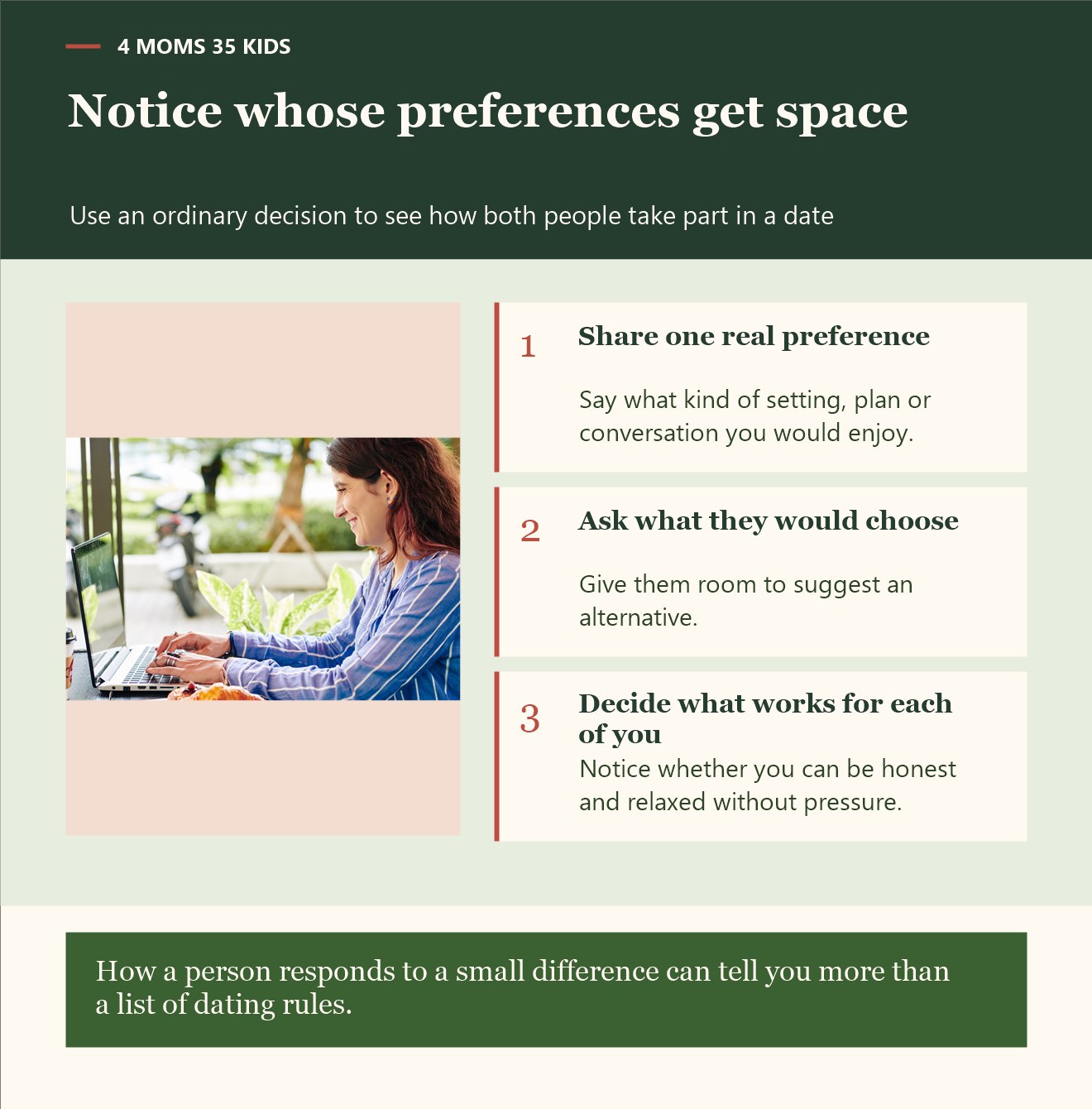
Read the infographic in text
Notice whose preferences get space
Use an ordinary decision to see how both people take part in a date
- Share one real preference Say what kind of setting, plan or conversation you would enjoy.
- Ask what they would choose Give them room to suggest an alternative.
- Decide what works for each of you Notice whether you can be honest and relaxed without pressure.
How a person responds to a small difference can tell you more than a list of dating rules.