

“Ask your village” can sound like advice from another world when family lives far away and friends have little capacity. Parenting without a support network is not a personal failure. Start with one task that another person or service could realistically help with.
Turn the pressure into a specific request
“I need help with everything” may describe your situation accurately, but a smaller request is easier to answer. Name the task, time and kind of help: “Could you collect the school forms on Tuesday?” or “Could you stay on the phone while I make these appointments?”
Separate the tasks only you can do from those someone else could take on. Support may involve childcare, transport, groceries, paperwork or listening. Emotional and administrative work count, even when no one is physically watching your child.
Find the point where help would matter most
Look at one difficult stretch of the week. Is the problem a school pickup that conflicts with work, meals after a long shift, or having no one to call when you are overwhelmed? Choose the pressure point before looking for a solution.
- Practical: “Could you bring one meal this Thursday? There is no need to stay.”
- Administrative: “Could you help me compare these two after-school options?”
- Emotional: “Could you listen for ten minutes? I don’t need advice today.”
- Backup: “If pickup runs late, may I call you? Please tell me what notice you would need.”
A person may be able to offer one kind of support and not another. A clear no gives you useful information for planning.
Build connections where you already go
Repeated, low-pressure contact can be more manageable than trying to create a whole network at once. A school group, library activity, parent program, community center or familiar place of worship may offer a starting point.
Begin with conversation and small, appropriate exchanges. You do not owe childcare, private information or unlimited availability in return for friendliness. Trust develops through behavior over time.
Reciprocity need not be perfectly equal. You might share information or pick up an item for someone while they help in a different way. Make arrangements explicit so generosity does not quietly become another demanding job.
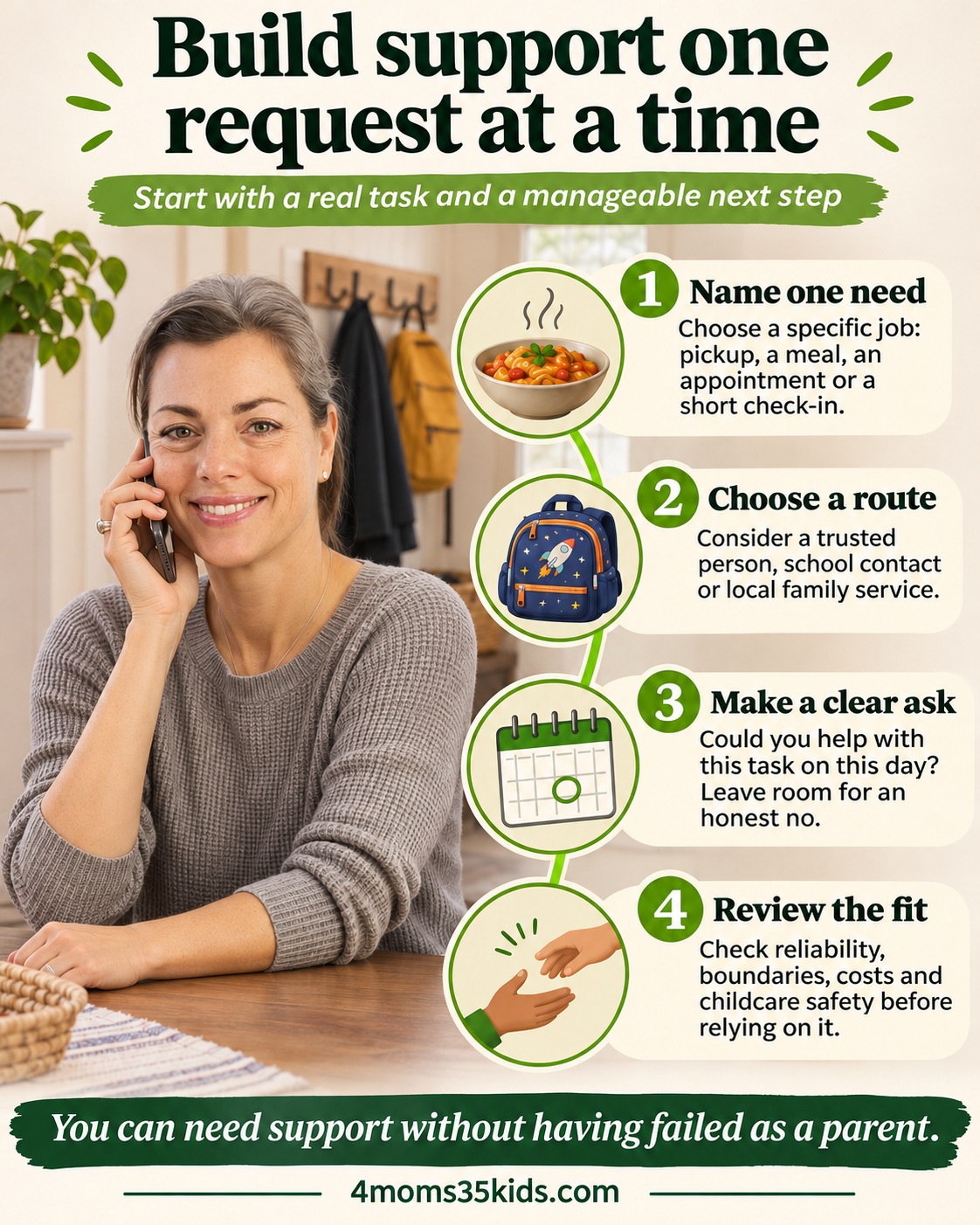
Read the visual guide as text
- Name one need. Choose a specific job: pickup, a meal, an appointment or a short check-in.
- Choose a route. Consider a trusted person, school contact or local family service.
- Make a clear ask. Could you help with this task on this day? Leave room for an honest no.
- Review the fit. Check reliability, boundaries, costs and childcare safety before relying on it.
You can need support without having failed as a parent.
Ask institutions about practical options
Ask your school, childcare provider, local family resource center or healthcare team what programs exist. Options and eligibility vary. There may be family support workers, subsidized activities, meal programs or help navigating services; an inquiry is not a promise that a place is available.
At work, describe the specific scheduling problem and ask what flexibility is possible. You can request information without sharing every family detail. Compare hours, transport, costs, accessibility and waiting lists before relying on a program.
Check childcare and protect privacy
Do not treat a friendly online exchange as a safety check. Before a childcare arrangement, discuss relevant experience, references, emergency procedures, who will be present, collection permissions and your child’s particular needs. Follow local requirements and take time to assess suitability.
Public requests should avoid your child’s full schedule, school details, home address or information that makes your household easy to locate. Move necessary details to an appropriate private channel after checking who you are dealing with.
Help that involves pressure, unsafe expectations or disrespect for your child is not useful simply because it is free.
Make a backup plan that is real
List who has actually agreed to help, what they can do and how to reach them. A backup contact should know they are a backup contact. Keep collection permissions and essential information up to date through the relevant school or provider.
Build a simpler version of the week too: easier meals, fewer optional commitments and a realistic standard for household tasks. Simplifying is a way to manage limited resources, not evidence that you have stopped caring.
If exhaustion, distress or safety concerns are becoming difficult to manage, ask for professional or urgent support appropriate to the situation. You do not have to wait until you have built a village to deserve help. One reliable arrangement is a useful beginning.