

When getting close to someone feels frightening, it can raise questions about trust, past experiences and what is happening in the relationship now. You do not have to rush toward intimacy or make a final decision about the future immediately.
Start with the particular concern and the choice in front of you. The ideas below offer ways to reflect, talk and decide on a pace that fits your life, without treating every hesitation as self-sabotage.
In this guide
1. Choose what to share and when
Closeness does not require telling someone everything at once. You can choose what to share, decide how much detail feels right and take time before a conversation that matters to you.
Try a clear statement about pace: “I want to keep getting to know you, and I’d like to take this slowly.” Then notice how the person responds. Their response gives you information about the relationship; you do not have to make yourself comfortable by ignoring a preference.

2. Separate past experiences from present events
A previous relationship may be part of what you think about when getting close to someone new. Ask yourself what happened this time, what you are worried might happen and whether there is something specific you want to ask about.
For example, a delayed reply can leave you uncertain without telling you the reason for the delay. You can discuss contact expectations rather than trying to work out someone’s intentions from one message.
Current behaviour matters too. Repeated pressure, dishonesty or disregard for your choices does not become acceptable because you have also been hurt before. If a breakup is part of the picture, see the guide to dating again at your own pace.
3. Respond to harsh self-judgement
Notice when a specific worry becomes a broad judgement about yourself, such as “No one could want to know me.” You do not have to replace it with a promise that a relationship will succeed. A more balanced thought might be, “I’m unsure how this will go, and I can take time to find out.”
Consider what you would like to ask for or change in the situation. You can be uncertain, need reassurance or prefer a slower pace without being worthless or responsible for another person’s choices.
4. Allow mixed feelings
You can enjoy someone’s company and still have questions about the relationship. You might be interested in another date while wanting more time before becoming exclusive or making an introduction to family.
Try naming the particular decision rather than demanding certainty about the whole future. “Would I like to meet again?” may be answerable even when “Will this relationship last?” is not.
Mixed feelings do not automatically tell you to stay or leave. Give attention to what is happening, what you want and what feels manageable.
5. Discuss what each of you wants
People may want different levels of contact, commitment or closeness. You do not need to measure whether you love each other by exactly the same amount, but you can talk about what each person is offering.
Ask a concrete question when it matters: “Are you looking for a committed relationship?” or “How often would you like to see each other?” Listen to the answer and consider whether it fits what you want.
If the answers differ, you can discuss the difference or decide that the relationship is not a fit. You do not have to make either person wrong to recognise a mismatch.
6. Keep other important connections
Consider how a new relationship fits alongside friends, family, work and care responsibilities. Becoming close to someone does not have to mean dropping every other connection or giving them all your available time.
You might keep a regular activity, plan time with a friend or explain that parenting commitments affect your availability. Ask about the other person’s commitments too.
A plan that leaves room for both people’s lives is more useful than assuming that changing all your routines proves how much you care.
7. Choose a next step without pressure
The next step might be another date, a question, a conversation about pace or some time apart. It can also be a decision not to continue. Fear is something to understand, rather than an order to push yourself into closeness.
The NHS guide to healthy relationships and mental wellbeing discusses communication, boundaries and outside support, including leaving a relationship that does not feel right.
If the worry feels difficult to work through, consider talking with a trusted person or a qualified counsellor. If you are afraid of how a partner may react, seek individual support rather than assuming you must resolve the issue together. You do not have to prove that you are ready for love by remaining in a situation you do not want.
Ask for something smaller than the proposed next step
If a new partner invites you to a weekend away, you could say, “I’m enjoying getting to know you. I’d rather plan a daytime outing for now.” See whether they can make room for your choice. You can decide later whether you want anything beyond it.
Read the infographic in text
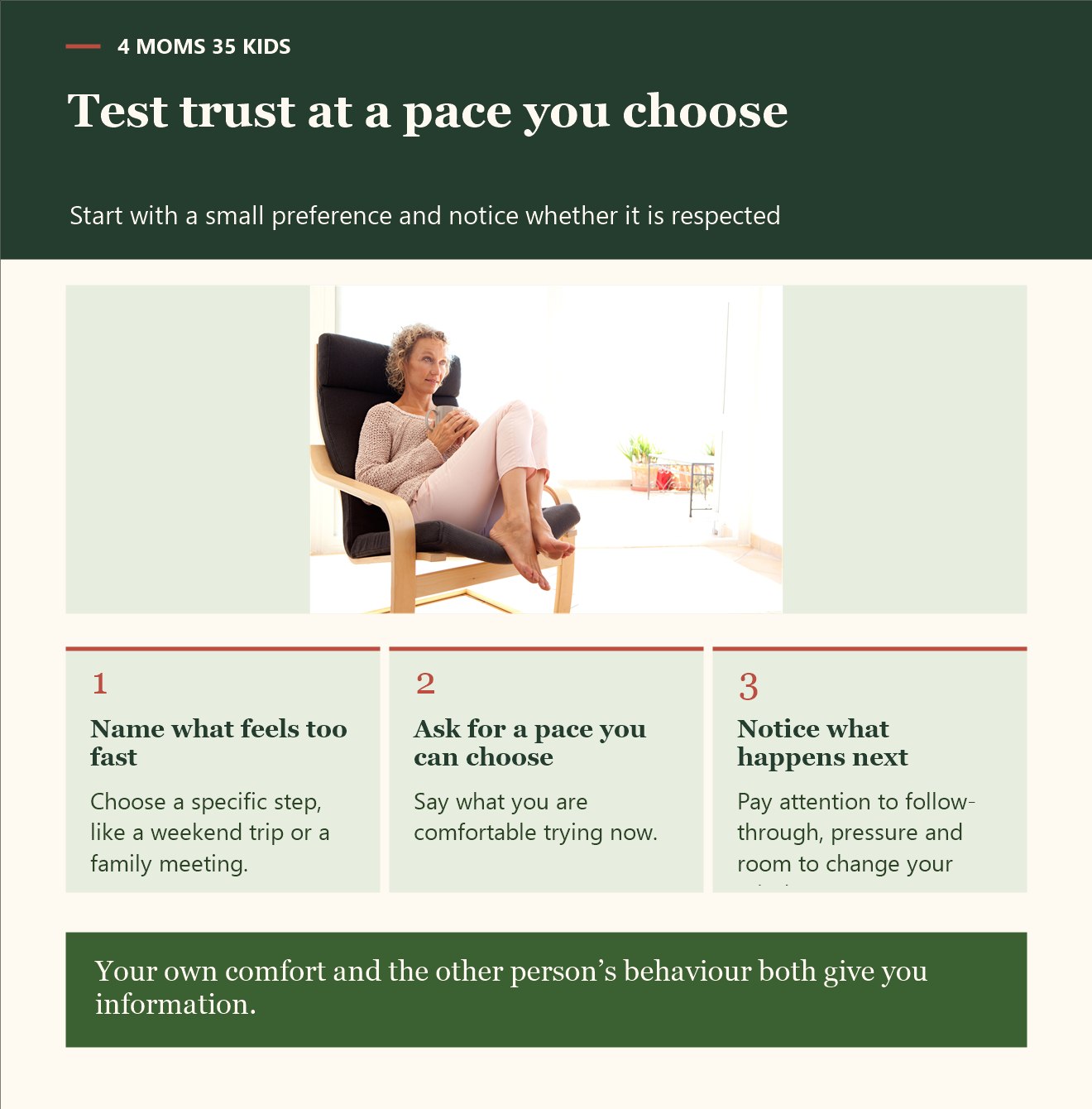
Test trust at a pace you choose
Start with a small preference and notice whether it is respected
- Name what feels too fast Choose a specific step, like a weekend trip or a family meeting.
- Ask for a pace you can choose Say what you are comfortable trying now.
- Notice what happens next Pay attention to follow-through, pressure and room to change your mind.
Your own comfort and the other person’s behaviour both give you information.