

Connecting with your child can happen during a story, a shared task or a few minutes of attention. You do not need to make every moment special, and a child does not have to respond with enthusiasm each time you offer time together.
Use the ideas below as options. Choose something that fits your child’s interests, age and comfort, as well as the time and energy available to you.
In this guide
1. Begin with something they enjoy
Ask your child to show you an interest rather than deciding what should count as meaningful time. That might be a book, a game, a favourite song or something they have made.
If you read together, let them choose a story or take turns deciding what to read. You can talk about a character or simply enjoy the story without turning it into a lesson.
You do not need to understand every interest immediately. “What do you like about this?” can be a useful opening. A game or programme can give you something to discuss, rather than automatically being treated as wasted time.
2. Offer attention without demanding a report
When there is a chance to talk, give the conversation the attention you can reasonably offer. If you are in the middle of something, explain when you can pause: “I want to hear that. Let me turn the stove off first.”
Try a specific, open question or follow something your child has already mentioned. They may prefer to talk while doing another activity rather than sitting face to face.
If they name a difficult feeling, acknowledge it before offering a solution. Ask whether they want help with the problem or would like you to listen. A brief answer or a wish not to talk right now does not need to become a test of how close you are.
3. Let affection and movement be a choice
Ask before a hug, a piggyback ride or a physical game, and accept a no. A smile, a wave, sitting nearby or spending time together can also express warmth. Children do not owe physical affection to make an adult feel appreciated.
The NSPCC’s guidance on children’s questions about personal boundaries explains that children should not be forced into hugs or kisses, including with family members.
For active time, choose an option that fits everyone’s abilities, energy and comfort. You might take a short walk, play a simple movement game or put on music. Let them decline or suggest a different activity, and stop when the game is no longer welcome.
4. Make waiting time more manageable
A queue or a delayed appointment can offer a small opening for a game, a joke or a shared observation. You might play a word game, draw together or ask each other to spot something in the room.
Keep the invitation light. A tired, hungry or overwhelmed child may need quiet, a practical comfort or a break rather than more entertainment.
Humour and dancing can be enjoyable when both of you want to join in. Avoid teasing about something your child finds upsetting or insisting they cheer up because you are trying to have fun.

5. Do something alongside each other
An ordinary task can be a way to spend time together. Choose a manageable part of preparing food, sorting materials, watering plants or tidying a shared space. Explain what you are doing and offer help where it is needed.
You can also draw or write together. If you use a shared notebook, agree which pages are for sharing; a child’s private diary does not become part of the activity without their permission.
Follow the conversation if one develops, and allow a quiet activity to remain quiet. Working alongside each other does not need to produce a deep discussion or a finished project.
6. Leave a familiar opening to connect
Look for a small, familiar opportunity: a few minutes after school, a bedtime story or a regular moment to ask about a current interest. Choose something that fits your actual day rather than adding a demanding new routine.
Looking through photographs can be another option. Let your child ask questions or choose the pictures, and respect that some memories may bring different feelings for each of you. They do not have to respond with the same nostalgia you feel.
If a planned moment falls through, explain and return to it when you can. You might say, “We did not get to our story yesterday. Would you like to choose one now?”
Connection can take different forms as children grow. Keep offering interest, listening and choices without asking any one activity to prove that you have spent enough time together.
Try a choice at an ordinary time
While supper is in the oven, offer to draw or sort the clean socks together. If your child says no, say, “I’m here until the timer goes off if you’d like company.” The CDC’s guide to connecting with toddlers and preschoolers explains active listening, praise and other ways to make everyday exchanges easier.
Read the infographic in text
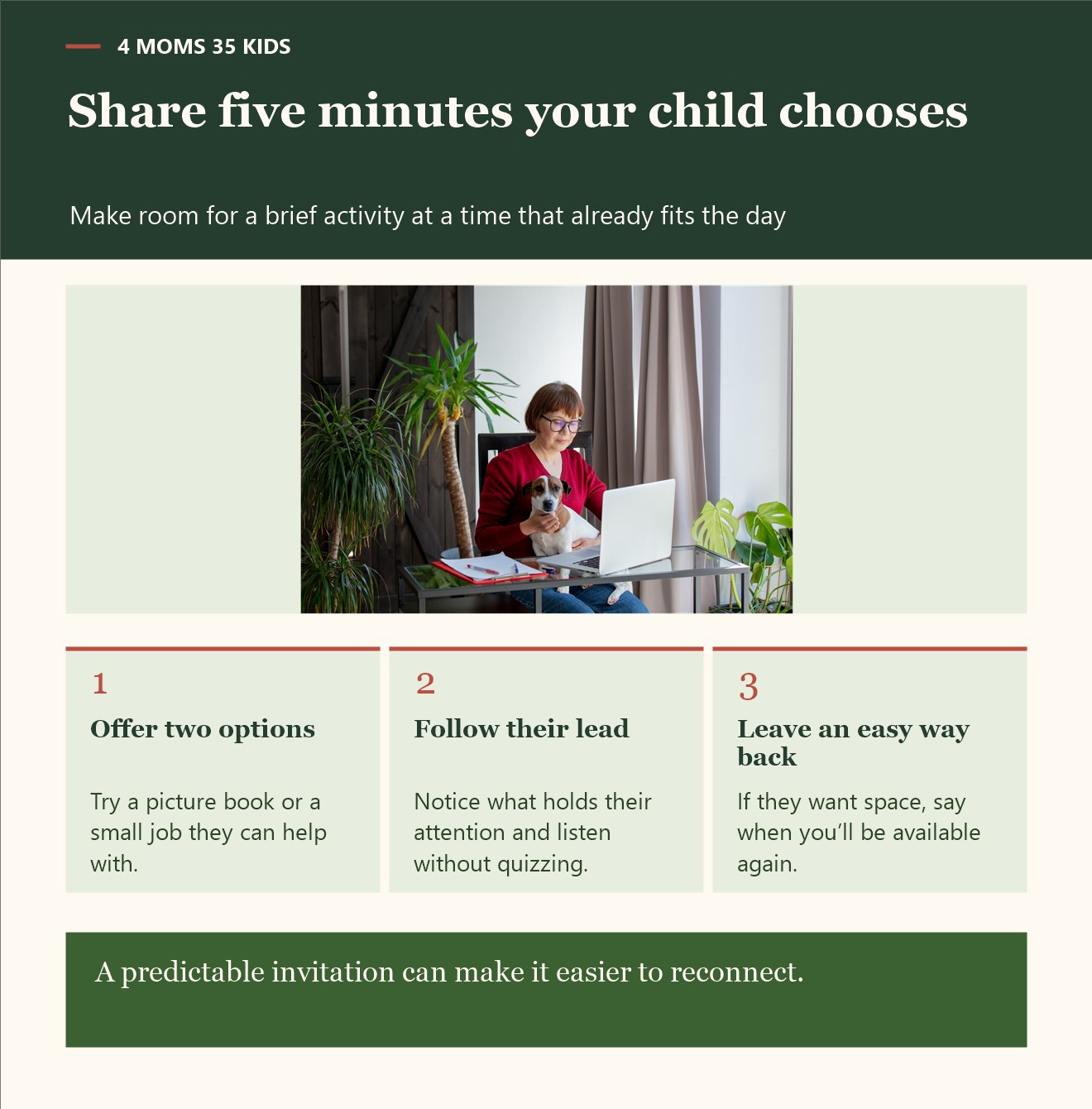
Share five minutes your child chooses
Make room for a brief activity at a time that already fits the day
- Offer two options Try a picture book or a small job they can help with.
- Follow their lead Notice what holds their attention and listen without quizzing.
- Leave an easy way back If they want space, say when you’ll be available again.
A predictable invitation can make it easier to reconnect.