

High expectations, worry and difficult interactions can leave you feeling stretched. It can help to look at a particular situation and the next choice available, instead of expecting yourself to control every thought or feel positive all the time.
The ideas below offer starting points for reflection and practical support. Try what feels manageable, and seek professional help when symptoms are distressing or interfering with daily life.
In this guide
1. Separate approval from your worth
Disagreement, a declined invitation or an unanswered message can feel personal. Before deciding that it proves something about your worth, identify what you actually know and what you are assuming.
For example, “They have not replied” is different from “Nobody cares about me.” There may be information you do not have. You can ask a clear question or give yourself time rather than treating the harshest explanation as settled fact.
The NHS guide to reframing unhelpful thoughts suggests examining the evidence and considering a neutral or more balanced view. You do not have to turn every difficult thought into a positive statement.
2. Make expectations more workable
When a task feels like a test of whether you are good enough, name what actually needs doing. What would count as a workable result today, and what could wait?
If something went wrong, describe the particular problem. “I missed the deadline and need to ask about the next step” gives you something to address. “I fail at everything” turns one event into a much broader judgement.
You can take responsibility for a mistake without requiring yourself to be perfect. Consider one adjustment or one request for help rather than rebuilding every routine at once.

3. Give a worry a specific next step
Write a concern in a short sentence if that helps you see it more clearly. Ask whether there is a practical action available now, something to schedule or information you are waiting for.
If there is an action, make it specific: what will you do, and when? If there is no useful action at the moment, consider returning to another activity rather than repeatedly checking for certainty.
The NHS guidance on tackling worries describes separating problems you can act on from hypothetical worries. You can try a short planned time to think things through if that approach suits you.
If news or social feeds are adding to the pressure, consider when and how you want to check them. Staying informed does not require keeping every update open throughout the day.
4. Choose boundaries around difficult interactions
A stressful interaction does not always call for ending a relationship or confronting someone immediately. Consider what happened, what you need and whether a conversation would be safe and useful.
A boundary might concern your availability, a topic you do not want to discuss or a request you cannot take on. “I cannot do pickup today; please make another arrangement” is clearer than hoping someone notices how stretched you feel.
If you are afraid of someone’s response, seek individual support rather than assuming you must resolve the issue face to face. Setting a boundary does not make you responsible for another person respecting it.
5. Focus on the part you can influence
Choose the decision that is available to you, even when the outcome remains uncertain. You might ask for clarification, prepare for an appointment or change the size of a task.
You cannot guarantee that another person will agree or that an uncomfortable feeling will disappear. A useful step can still be worth taking while you feel unsure.
Notice the difference between something you can choose and something you need help with. Time, health, care responsibilities and other circumstances can affect what is manageable. Adjusting a plan can be a practical response rather than a personal failure.
6. Use support when self-help is not enough
Make room for basic care and connection in ways that fit your circumstances. That might mean a regular meal, a chance to rest or asking someone you trust for practical help. These are options to support you, rather than a test you must pass before seeking care.
The National Institute of Mental Health’s guidance on caring for mental health recommends professional help for severe or distressing symptoms lasting two weeks or more, including difficulty sleeping, concentrating or completing usual activities. You can contact a healthcare professional sooner if you are concerned; you do not need to wait for symptoms to become severe.
If you are in immediate danger or might act on thoughts of harming yourself, contact local emergency or crisis support now. In the United States, call or text 988 for the Suicide & Crisis Lifeline.
Choose one useful next step, including getting support. Mental wellbeing does not depend on keeping complete control of your thoughts or feeling happy all the time.
Make an expectation specific enough to change
If you’re expecting yourself to be available to everyone, decide who needs an answer today and put the rest on a list for tomorrow. You could let a friend know when you can actually talk. The National Institute of Mental Health’s guide to caring for mental health explains when self-care options and professional support may help.
Read the infographic in text
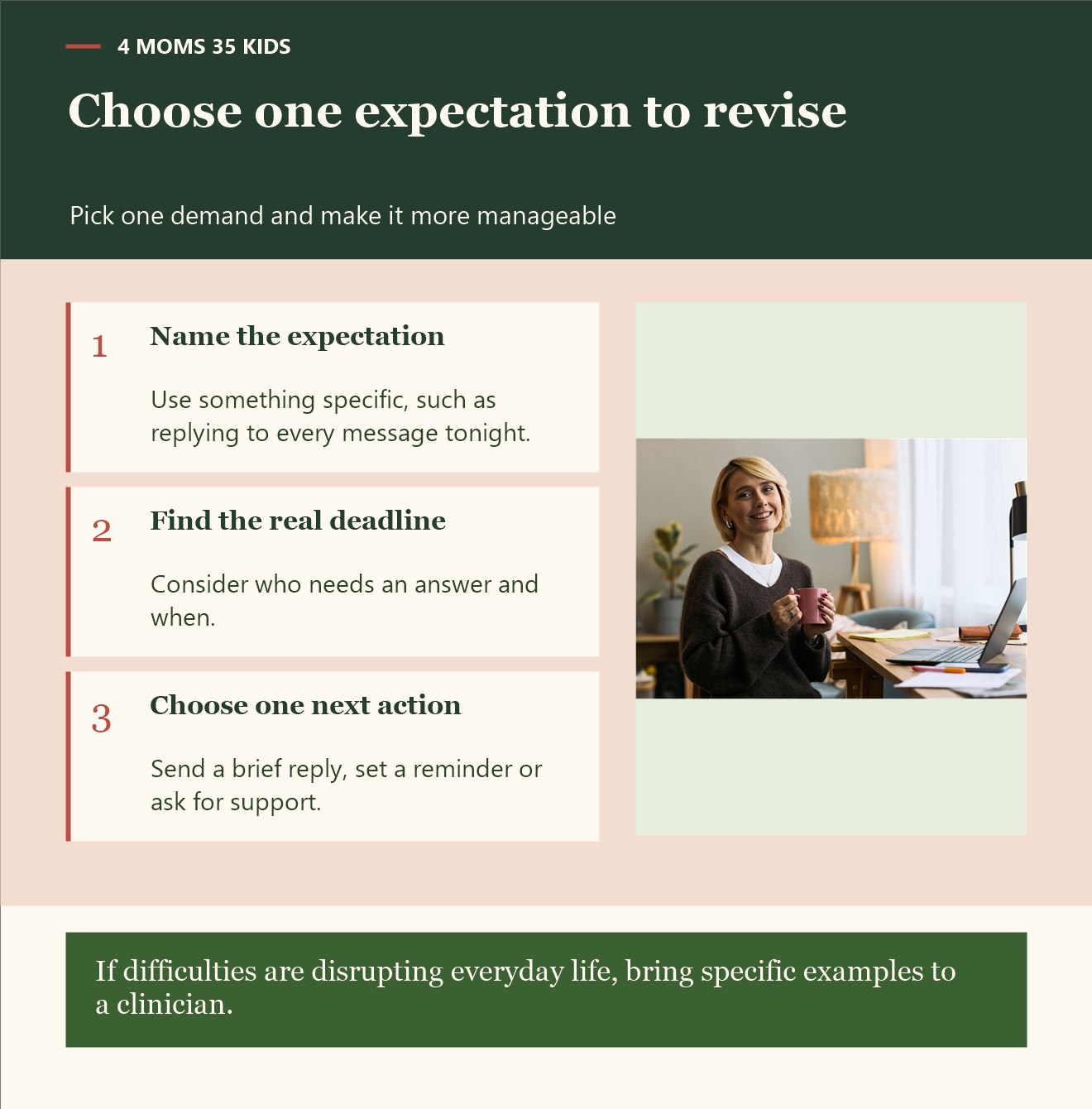
Choose one expectation to revise
Pick one demand and make it more manageable
- Name the expectation Use something specific, such as replying to every message tonight.
- Find the real deadline Consider who needs an answer and when.
- Choose one next action Send a brief reply, set a reminder or ask for support.
If difficulties are disrupting everyday life, bring specific examples to a clinician.