

Looking back can help you notice what has changed and decide what matters next. It can also become another comparison: you should be further ahead, doing more or managing family life better by now.
Your past and future selves do not need to be opponents. A useful review considers your circumstances, recognises what you have carried and gives you a manageable next choice. It does not require a verdict on your worth.
On this page
Compare circumstances before judging progress
A goal made before a new baby, an illness, a separation or a change at work may no longer fit the same timetable. You may have different money, time, energy or support available now. Include those facts when you look back.
For example, completing fewer personal projects during a demanding period of care does not tell the whole story. What responsibilities were you managing? What did you have to postpone? What choices were realistically available?
You can take responsibility for a particular decision without deciding that you are lazy, selfish or your own worst enemy. Describe what happened as specifically as you can. A missed appointment and a whole-person judgement are different kinds of statements.

Notice what you have learned and maintained
Progress can include something you have kept going: a household routine, a friendship, a medical appointment or a conversation you used to avoid. It may also include stopping a commitment that was no longer workable.
Try three short prompts:
- What was difficult, and what helped me manage it?
- What do I understand better than I did before?
- What would I like to carry forward or change?
You do not have to find a benefit in every painful experience. Some events remain unfair or upsetting. You can acknowledge what happened without making gratitude or personal growth a condition of moving on.
If looking back becomes overwhelming, set the exercise aside. You can return another day, talk with someone you trust or focus on what you need now.
Choose a direction that fits your life now
Ask what you want more room for: rest, learning, steadier finances, time with family, friendship or a personal interest. You can have several priorities, and they may compete for the same limited time.
Make the choice concrete. “Be a better parent” is hard to act on or measure fairly. “Ask my child what they enjoyed today and listen without multitasking” gives you a specific opportunity, when the day allows.
Your future does not have to match someone else’s family timetable, income or relationship status. Other people’s achievements can offer ideas without becoming a ranking of whose life is more valuable.
Make one next step smaller
Choose a step that fits an ordinary day rather than your most energetic day. That could be finding one class timetable, preparing a question for an appointment or asking someone to share a recurring task.
Name the likely obstacle as well. If you need childcare, transport, information or money, put that need beside the goal. It is useful information, not evidence that you have failed to want the goal enough.
You might write: “I want to spend time on this interest. My next step is to ask about the cost and schedule.” You can decide whether to continue after you have those answers.
For more practical ways to reduce the size of a task, see 10 Manageable Steps When Motivation Is Low.
Review the plan with fairness and support
After trying a step, ask what happened. Was it workable? Did the circumstances change? Would help, a different approach or a pause make more sense? Adjusting a plan is part of making it useful.
If you hurt someone, a specific apology or repair may matter more than measuring how much you have improved. If the barrier is outside your control, consider what support or information might make the situation more manageable.
You can care about your future while treating yourself fairly today. Your next choice does not need to prove that you have defeated your past self.
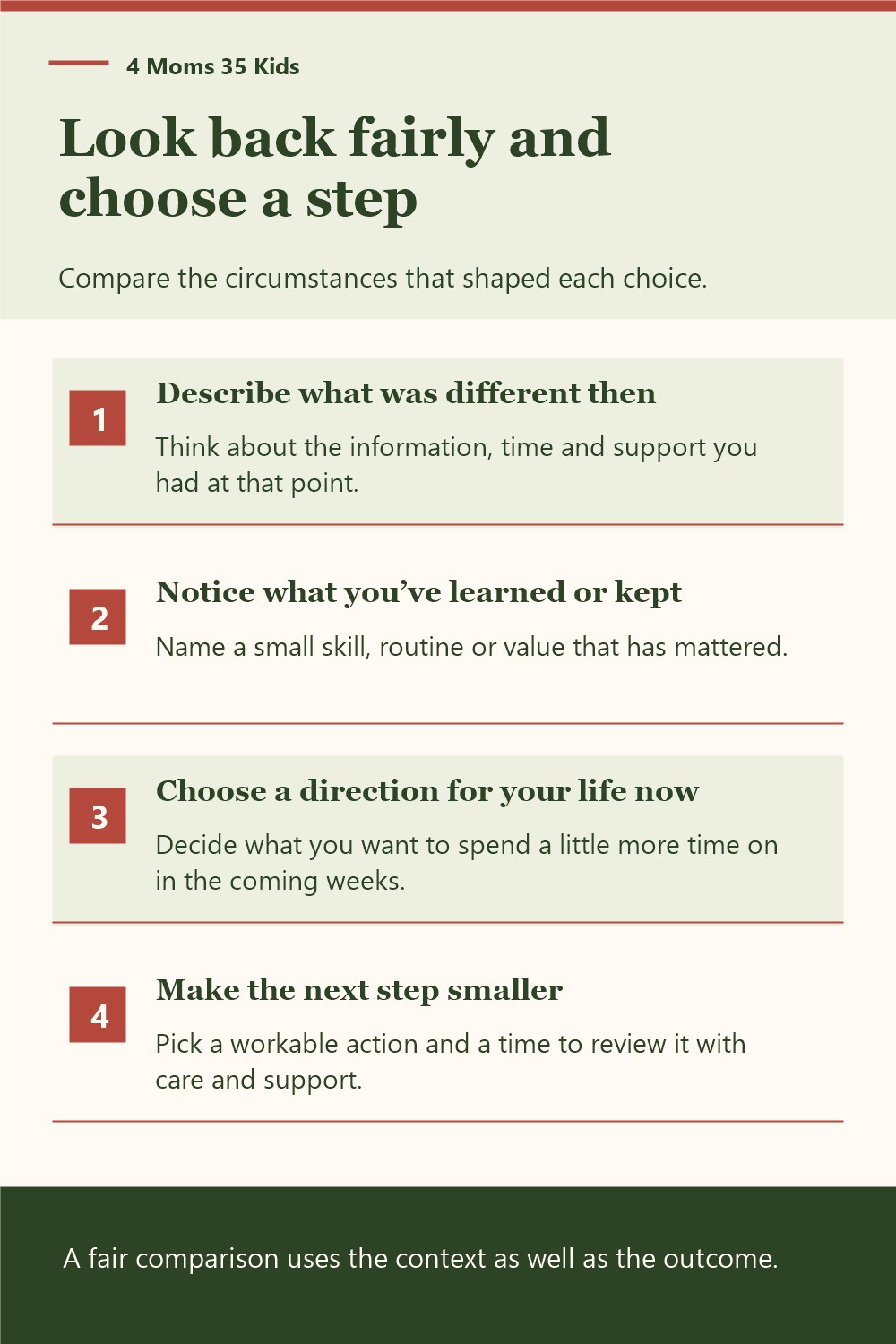
Read the infographic in text
Look back fairly and choose a step Compare the circumstances that shaped each choice.
- Describe what was different then Think about the information, time and support you had at that point.
- Notice what you’ve learned or kept Name a small skill, routine or value that has mattered.
- Choose a direction for your life now Decide what you want to spend a little more time on in the coming weeks.
- Make the next step smaller Pick a workable action and a time to review it with care and support.
A fair comparison uses the context as well as the outcome.